I woke up early this morning; I couldn't sleep. Something was nagging at me, floating at the edge of my conscious. So I got up, wandered around the flat a little, avoided looking at our bags lying on the floor from Egypt (still to be unpacked), looked at the clock (6:30am), sat on the couch, then saw the laptop power light flicking at me, beckoning me to write about Egypt before all the mind videos, still images, sounds, smells and sights left my head.
I think this blog has become more of a serious undertaking than what it was first intended to be. Geez, I didn't even know if it'd last past the first few posts. But here I am, 6 months on and 40 plus posts later. You know what, sometimes I even see things and think
that'd be great on the blog, must snap that one *click*. So my lovely 14 readers, if you haven't abandoned me already (he he), you are reading something that is just a tad bit special, something that I think about a lot and something that comes right from the heart.
'And now we interrupt this soppy rant for the REAL story.'
And that's all about Egypt. I warn you, this is going to be another of my mammoth posts, I can feel it. I considered doing it in two parts, for my writing to seem a little more modest. But alas, my pedantic nature wouldn't allow it, and the pattern of one post per country has to be maintained. So, get comfy, pry those eyes open with toothpicks, and here goes...
As you are probably aware, Egypt is in the grips of a revolution. I knew this before our trip, but I knew very little about what this really meant. Don't get me wrong, it's not a safety issue, danger's not lurking around every corner, in fact I felt as safe there as I do here in Brighton. What it is about is fairness for the people. Speaking to our local guides about it all, brings up the word corruption. A government that, up until early February this year, was not fair to it's people. It's the usual quandary: money wasn't going to the right places. This is a big deal in a third world country, where 60% of the population are living below the poverty line. And do you know, one of the saddest things about this revolution? It's kicked the bottom out of the biggest money making industry Egypt has: Tourism. Our guides would often tell us how normally we'd have to wait for hours to see attractions, how hotels would be full, buses would be a dime a dozen and the number of people booked on a tour would equate to more than 3 (yes that's right, 3 people on the tour after ours - we had 27, primarily due to it being school holidays, us travelling teachers and all...). So for us, it's all been really peaceful and pleasant, hotels are quiet, straight in to see the monuments, no crowds and things are cheap (I'll tell you about our cruise upgrade later). But this means tough times for the Egyptians. It was hard to ignore the raw desperation of some of the locals in the face of this crisis. Walking through the markets in some places was a marathon. Each vendor desperately trying to make a sale, pleading with you to look at their wares, calling out one after the other. In the hot Egyptian sun, it was obvious that the bright colours of their cheap t-shirts and kaftans were fading. I guess stock isn't moving, and I wonder how long it's been for each of them since they last made a sale? What difference has this made to maintain their family? There are heaps of stalls, but you can only buy from one or two. It's sad really, how healthy the industry once was, and how things can change so quickly. Tourism is Egypt's primary industry. I just hope the revolution makes true the governmental changes they are desperate for, to make these difficult times worth it.
So what do the Egyptians want from all this? One things is employment. University leavers graduate into unemployment, or into jobs below their expertise. Take the masseuse in our hotel in Dahab, he is a fully qualified physiotherapist and has worked previously in the hospitals. He just seems so overqualified to be giving massages. Yet when you think about it, how many people in Egypt would be able to afford the consultations with a physiotherapist, or how would spend what little money they have on this? And from what I can gather, it's very very hard for Egyptians to seek working visas overseas. The real sadness of this is how greatly the world you're born into effects your station in life. But that's one of the injustices of this world... I just hope the future will bring a change for the better to the people in Egypt.
Well, now that I've had a bit of a heart to heart, I do want to tell you about some of the exciting things we've done in Egypt. Who knows, maybe you might pick this as a future holiday destination. I thoroughly recommend it.
So without further ado, here's my top 8 of Egypt:
1. Giza Plateau - The Three famous Pyramids and the Egyptian Museum (Cairo)
It was a pretty surreal experience to be driving through the city, only to see the tops of the pyramids appear above the buildings, and the sands of the deserts extending far beyond them. The city's expansion has meant that the pyramids are now really on the outskirts of Cairo. Have a look at this crazy picture below:
It was steaming hot this day (as it was most days). We wandered around the pyramids and went down into one to see the tomb (not super impressive
 |
| Keen to make a sale |
 |
| the Sphinx is far smaller than I imagined... |
 |
| The body of a lion and the head of the human makes for a powerful and intelligent embodiment... |
Glen was hassled by an Arab man on a horse, who told him he was the son of the mayor of Egypt and a holyman (hmm.... yeah right). He followed us around everywhere, would have a bit of a chat, and we chatted back as is the Aussie way (this banter worked a treat with all Egyptians, a smile and a joke go a long way), yet we should have saved our breath on this man. he kept following us and so we started to ignore him. He would say 'Ok goodbye my friends' but still keep talking to us. We weren't too worried, there were tonnes of tourists around, but when he started throwing some little scarab beads at us, and demanding money, we started to get a bit peeved. Glen gave him an English pound and sent him on his way. But it's this kind of aggression that makes you not want to help people. He was quite a rotund man, so I don't know that he was desperate for the means to feed himself. I know of others at the pyramids who got persuaded to sit on camels for a photo, and then asked to pay for a ride. Yet this was our only real hiccup with the locals all trip, and a minor one at that.
The Egypt museum was an amazing store of thousands of antiquities. No photos allowed, but certainly some amazing sights I can list. Tutankhamen's treasures: his is the only Pharaoh's tomb ever found intact, not pillaged by grave robbers. All the gold and treasures of this tomb are only displayed in the museum, including his very famous death mask and two of his three coffins (the other is in his tomb in the Valley of the Kings - he was encased in coffins like a babushka doll). Other crazy things on display include jewellery, his beds, chariots, shoes, even underwear and his first condom---how very interesting! We even got to see a number of mummified Pharaohs and Queens - black shrivelled but still maintaining the features of a human being - 2000 years later.
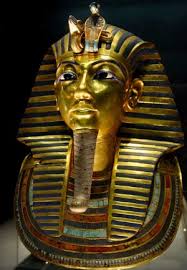 |
| Tutankhamen's death mask |
2. The Valley of the Kings
I have no photos of my own to show here, but I'll do a little explaining all the same. The Pharaohs were buried here in tombs. This was an out of the way place and somewhat discreet. Above ground you wouldn't know there were tombs here, just piles of rock and sand. But underground - wowee. Beautifully decorated chambers. Lots of the paintings still retaining their colour. Most of these tombs were robbed of their contents, but it was here that Tutankhamen's tomb was found intact. There are over 60 tombs here, and they're still discovering more as we speak. I pasted these photos from the net so you can see what the valley looks like.
 |
| You can see a tomb entrance in the centre |
 |
| I went inside this one! |
3. Abu Simbel
This was another major highlight of the trip. A long bus trip and about 1000km from Cairo is the town of Aswan and just outside of this is Abu Simbel two temples constructed by Pharaoh Ramses II, one for himself and one for his wife, Nefertari. From what I can gather, these were erected to show how great he was. To look upon these enormous sculptures built in the 13th century BC was just amazing. Inside were fastidiously carved scenes paying respect to Ramses and his greatness. The workmanship is really something. And this guy didn't do things by halves. he is probably one of the most famous Pharaohs, most notably for having a heap of wives, including 3 of his daughters and his a niece! over 160 children - wowee!
 |
| This one was built for wife, Nefertari. You can still see statues of Ramses here though, four of him and two of her |
These temples have actually been moved. They originally stood where these is now a dam. So were moved piece by piece to this higher location - impressive.
We visited a number of other temples too. Built by various Pharaohs, some dedicated to the gods of land and sky and another to the god of war. We were able to take some photos inside of these. And the interiors were fairly similar across the temples. have a look at how amazing the art work was inside. And to imagine this was all painted in colour too!
 |
| Notice the damage caused to the carvings. Often by the later Christians. Eyes were chipped out or removed because they often looked too realistic (in statues in particular), I'm pretty sure the damage to the skin meant deformity in resurrection. |
 |
| Damage by Christians, it's a cross |
 |
| Dominating exterior |
 |
| Look at these colours, still in existence today. This picture depicts offerings to a god |
 |
| Hieroglyphics |
I can't help but add a few more pictures. These are a collection of photos from a number of temples we visited: Karnak, Luxor, Edfu and Philae are just some of the names.
 |
| Monument to Horace, the God of War. He's pictured with a human body and a bird head |
 |
| They've just begun to uncover a road of sphinx, 3km long from one temple to the next. There are still a heap underground |
 |
| This is Tutankhamen and his wife - he looks so young! Rightly so, he died in his late teens |
 |
| Best preserved statue in Egypt, is was buried under the sands of the dessert for hundreds of years |
4. Dahab
Dahab was a spur of the moment decision for us. We were originally on the trip for 9 days. But given the quiet tourism industry in Egypt at the moment, the price to do things is pretty cheap. So we jumped on board part 2 of the trip. After having our lovely tour leader Rafik help us to change our flights (for free - yay) we paid a little extra and headed off to Dahab.
Dahab is a small coastal town on the red sea. A really relaxed atmosphere, crystal clear waters and really friendly people. Here is a montage of our favourite things in Dahab.
 |
| Our Hotel - Miami Beach Resort |
 |
| And the pool |
 |
| A bit of soccer action with the staff at the hotel. There were about 15 guests in the whole hotel, very quiet, so enough time for a game, or two... |
 |
| There's the chef in green |
 |
| The other chef in red and the gift shop guy on the left |
 |
| Group shot |
 |
| Throughout the Sinai area we were accompanied by Bedouin leaders. The tour company hires them, just as a security precaution. Apparently if you're with the Bedouins, no one will mess with you. Their names were Mohamed and Mohamed (the most popular name in Egypt). On the last night they organised a traditional Bedouin meal for us, the sort of meal they'd have on their camp out in the desert. It was great, and we were the first group they'd done this for, special... |
 |
| Bedouin tea, sweet and delicious |
 |
| Glen enjoying dinner |
 |
| Back in town at our favourite restaurant over the water: 'Same Same but Different'. Coconut and chocolate thickshakes...yumo |
 |
| A little bit of dancing was had, and here are some of the fabo people we spent the trip with. Such a lovely group |
 |
| Glen and Nick busting a move |
 |
| Looking out over the Dahab waterfront at night |
 |
| With Jaye and the Bedouin Mohamed |
5. Snorkeling in the Red Sea
Some say it's just as nice as our Great Barrier Reef. I would probably have to agree. We spent a lovely morning snorkeling in The Blue Hole, beautiful coral and fish, plus heaps of divers dropping down to explore the depths.
 |
| Can you see it, the Blue Hole |
 |
| Love snorkeling |
 |
| Lunch |
 |
| Little mate who made me a bracelet, awwww |
6. Hike up Mount Sinai
Number six on the list is Mount Sinai. This is famed as the mountain upon which Moses received the Ten Commandments. All I can say is that Moses must have been a fit man (or at least he had good shoes). I'm such a thinker, didn't bother to pack lace up shoes, too heavy and a waste of space in the heat of Egypt. Little did I know we'd be hiking a twenty kilometre round trip: up Mount Sinai then down again. So in my El cheapo sandals (at least they attached around my ankle - it could have been worse in flip flops), I hiked up the mountain in the darkness to see the sunrise.
And wasn't it a beautiful one.
 |
| Pretty cold at the top, we had to hire a blanket |
 |
| And the sun rises....beautiful |
 |
| Our guide, Falcon. He often walks up a twice a day |
 |
| Look at that view, is this what Moses looked down on? |
7. Nile River Cruise
We were very lucky to upgrade our Nile sailing. Originally we'd been booked in on a Felucca, to sail down the Nile for two days. This is basically a wide sailing boat with a canopy, a narrow foam mattresses and not much else. No toilet, you have to pull ashore for that business. Well, given the heat of the day, we all leapt at the opportunity to upgrade to a Nile cruise for $80US for 3 nights. It was a pretty flash ship and well worth its weight in air-conditioning. All meals included, we were set.
 |
| Our cruise ship, the Renaissance |
 |
| The lounge bar area |
 |
| Strike a pose. Glen spent a bit of time on deck doing some shipspotting, watching the ship go under bridges, seeing it go through the locks to a lower water level, you know, that sort of exciting stuff |
 |
| Galabia party on board the cruise. based on traditional Arab dress |
 |
| Glen with Mohamed, who did his fancy head piece for him |
 |
| Some wannabe Arabs |
 |
| Great night with great people |
 |
| Argh, attacked by pirates. Nah, it's just the market vendors desperate to make a sale |
 |
| Towel folding extraordinaire |
 |
| Loved this one! |
8. Nubian Desert Visit
Nubia was once a kingdom in the south of Egypt that stretched across to Sudan. Once upon a time they had their own ruler and their own language. But a few hundred years ago this kingdom collapsed, and Nubia joined with Egypt and Sudan. While it's not a separate country today, the people in this region still identify themselves as Nubians. They have a proud sense of their heritage and its importance, which I think is a great thing.
We spent an afternoon cruising up the Nile towards a Nubian village, where we had dinner. Some people swam in the Nile, Glen took a camel ride, we went to have a lesson in Nubian and Arabic and Glen made a little friend.
 |
| Nile boat ride |
 |
| Looking across the Nile to the Sahara |
 |
| Another tiny pirate. These little guys would paddle up on a piece of wood, latch on and sing for money |
 |
| Our boat drivers and looking back down the river |
 |
| Our boat |
 |
| The sand, it's bright gold |
 |
| This guy was so persuasive I bought a little bracelet |
 |
| Glenny on the camel |
 |
| In the school room, writing my name in Arabic |
 |
| I think I did ok... |
 |
| Glen's little mate, another Mohamed. He loved to pose for a photo then see himself on the playback |
 |
| Our tour leader, Rafik. He was the best. |
Of all the countries I was nervous about visiting, Egypt topped the list. it seems so foolish now because we had such an amazing time. Maybe we were lucky, or maybe that's just the way things are. But you have to remember the dissent in Egypt has nothing to do with the tourists. And while protests are still happening across the country, we saw none of it. May I venture to say that this is the best place we've ever visited? I think I may.
Glen and Stacey's Guide to Haggling
Before I go I'll leave you with our guide to haggling with the locals. Of course haggling (or bargaining) is part and parcel of market shopping in many countries, and my all means an expectation of the market vendors, who are are more than content to start with a price relevant to pearls when you're buying a plastic magnet. From one country to the next, it all seems pretty much the same and while you're not shopping to get dirt cheap prices, you are there to get a good price or a bargain (and certainly not ripped off). So here it is:
1. "Hello Lady, you come and look at my stuff, hello? hello?" You're walking through the markets, past vendors and they are yelling all sorts of phrases similar to the above. You really need to have in mind what you want to buy, if anything, as once you stop to look, it becomes difficult to extricate yourself. Glen and I always buy a magnet from places we visit.
2. So you stop at a stall. The first things they'll say is: "Hello my friend, where you from?" The answer to this will obviously be a reflection of how much money you have and therefore how high they'll set the bargaining. Thankfully Aussies seem to have a good reputation the world over, so it's ok to say "Australia". This will inevitably receive the reply "Aussie, Aussie, Aussie, oi oi oi". Another good reply that our tour leader suggested to us is to say "Tasmania". For a few reasons this one puts you in better stead for bargaining. Firstly, the vendor wouldn't have heard of Tassie, so immediately it throws them off guard, they don't usually ask you where this is, but instead say "Ah Tasmania" with no clue really. If they do ask, I usually say it's an island (which is sort of true). Secondly, they may assume it's some sort of Eastern European country, which is good for us, as these countries have a reputedly lower economy, suggesting we're not the wealthiest travellers.
3. Never fall in love with something (outwardly). Even if it's something you must have, pretend, you're only half interested. Look at the item, look around the stall a little, walk off, come back. Pretend it's something you may want, but not something you're super interested in. Be careful, if it is something you really only half like, once you get into bargaining for it, it's hard to break out. And if you bargain to a good price, then decide you don't want it and walk away, that's pretty rude. So if you decide, the item is something you must have, let the bargaining begin.
4. "How much?" you ask. Usually they will set you a highly inflated price, or will ask you for a price, to which they will counter set a highly inflated price. Now depending on the country, you should aim to settle on a price anywhere between half and a third of the original price. So automatically, give them a price a little lower than you're prepared to pay. They will whistle or laugh, tell you how low that price is and proceed to point out the amazing qualities of the little plastic magnet. Now here is where it's important to keep it all light hearted. We sat next to an American couple on the beach in Rio bargaining for two sarongs. The poor vendor wanted to make the sale, but the American bloke was adamant at getting the sarongs at dirt cheap prices. It got aggressive and heated and I really felt sorry for the vendor who desperately wanted the sale at a reasonable price. I think it's really important to smile and laugh, you're not cutting million dollar deals here.
5. So you insist on a lower price, but they come back with "Oh, no, you give me your best price, please please?" So maybe you add on 5 or 10. For me, this usually takes me up to half the original price; what I want to pay. And from here they will drop down maybe 10 or 15 from their original price. And so you reach a stalwart. My strategy here is to pretend I don't want it. Shake your head, learn to say "no thank you" in the local language, smile and walk away.
6. And the price begins to drop. They will bombard you with offers, to which you can reply "No thankyou" and continue to back away until you hear one you're happy with. In some countries the price will never get to a point at which you're prepared to pay, so do you pay a little more or do you really walk away? Other countries will usually meet you at or a little above your ideal price.
7. It's really important to have fun with it all. In the end, the vendor needs to make a living, and they will always make some sort of profit on each sale. Sometimes you need to remember the fact that life for them is probably a lot more difficult than your own. So ultimately, if you did pay a little too much, console yourself with the fact that you're boosting the country's economy, giving a charitable donation to those who probably need those couple of dollars a lot more than you do!


.jpg)


0 comments:
Post a Comment